
OEM Perfume Cost Breakdown: Logistics Lines a Drugstore Buyer Misses
A drugstore own-brand fragrance is bought on landed cost and negotiated on production price, and the gap between the two is where ranges quietly lose their margin. Production and filling are the lines a supplier quotes directly; freight, duty, packaging compliance, decoration yield and per-order fulfilment arrive later and are rarely compared across suppliers. A buyer who builds the full landed cost table before awarding the range discovers which of two apparently similar quotes is actually cheaper.
Key takeaways
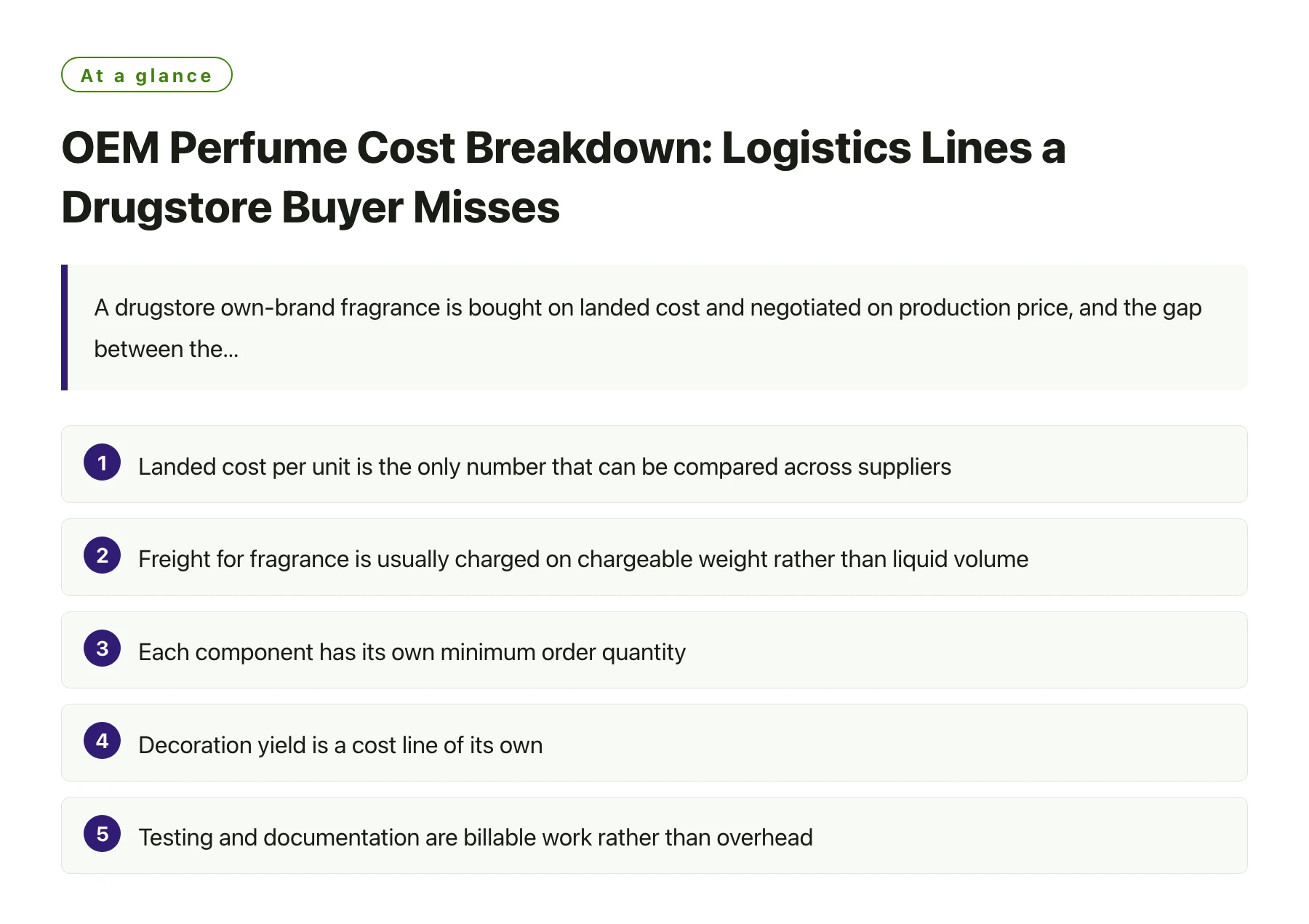
- Landed cost per unit is the only number that can be compared across suppliers, because production, freight and duty sit in different places in different quotes.
- Freight for fragrance is usually charged on chargeable weight rather than liquid volume, so bottle weight and pack design move the bill as much as the fill does.
- Each component has its own minimum order quantity, and the smallest viable order is set by the component with the longest lead time rather than by the fragrance.
- Decoration yield is a cost line of its own, and asking how rework is charged is a faster way to compare two decoration quotes than comparing the unit rates.
- Testing and documentation are billable work rather than overhead, and treating them as an afterthought hides a real per-unit cost [1].
- Packaging rules in the destination market can add obligations that sit with the brand, and those obligations have a cost even when they are not paid to the supplier [2].
Two suppliers can quote the same fragrance at the same production price and deliver very different landed costs. One packs in a heavier bottle, ships on a schedule that consolidates well, and absorbs decoration rework without a conversation. The other quotes a lower unit price, ships in smaller lots and hands every variation back to the brand as an amendment.
The reason this is easy to miss is that the production quote is a single, well-formatted document, while everything else is scattered across freight quotes, duty calculations, decoration invoices and warehouse bills. The fix is not a better negotiation. It is a template that puts every line in one place before the comparison starts.
Why the production quote is not the cost
A production quote normally covers what the manufacturer controls: materials, filling, assembly, and sometimes the pack. Everything after the factory gate belongs to someone else, and that is where a range's economics are decided. A supplier such as Xuelei Fragrance Xuelei Fragrance can quote production, filling and pack in a single line, and the remaining lines still sit with the brand, which is why the two need to be modelled together.
The direction of the difference matters as much as the size. Heavier bottles raise freight, duty is charged on declared value, and a range that ships in small frequent lots pays more per unit for the same goods than one that consolidates. None of those lines appears in a comparison of production prices.
The lines that make up a landed cost
| Cost line | What drives it | How to verify it |
|---|---|---|
| Fragrance compound | Concentration, material class and fill volume, not the note description | Ask for the fill and the concentration to be stated in the quote, and compare like with like |
| Bottle, cap and pump | Tooling or mould choice, component minimums and available stock grades | Request the minimum for each component separately rather than a single order minimum |
| Decoration | Process choice, yield and rework handling, and whether decoration is in-house or subcontracted | Ask what percentage yield the quote assumes and who pays when the run comes in below it |
| Filling and assembly | Line time, hand assembly, inspection and any special handling for the pack | Confirm what is included, particularly whether labelling and cartoning are in scope |
| Testing and documentation | Stability, compatibility and declaration work, plus repeats after a change | Get the test list named with a price per test, and check which party commissions each one [1] |
| Freight and insurance | Chargeable weight, volume, sailing frequency and whether the lane treats the goods as dangerous | Ask for chargeable weight per carton, not just the liquid volume |
| Duty, tax and clearance | Classification, declared value and the destination market | Confirm the classification used and the duty rate applied to it |
| Packaging obligations | Recycled content, reporting or labelling duties in the destination market | Check what the destination asks of the party placing the product on the market [2] |
| Warehousing and fulfilment | Storage, pick and pack for individual orders, and returns handling | For a subscription model, price the pick-and-pack per order rather than per carton |
Once the table is complete, the comparison changes shape: the supplier with the lowest production price is frequently not the supplier with the lowest landed cost.
Reading the comparison without being misled
The first discipline is to compare at one volume and one destination. A quote built on a single large shipment and a quote built on monthly parcels describe different businesses, and the per-unit numbers they produce are not comparable until the volume and cadence are fixed. Comparing fragrance quotations is mostly an exercise in making assumptions visible, which is what reading a perfume price breakdown reading a perfume price breakdown amounts to once the formatting stops being persuasive.
The second is to separate fixed from variable costs. Tooling, artwork and testing are paid once, while compound, components, freight and duty scale with volume. Mixing them produces an average unit cost that is accurate at exactly one order size and misleading at every other, which is a problem for a subscription range whose volumes are expected to move.
The third is to put a number on rework and revision. Decoration yield, artwork changes after approval, and re-tests after a formula adjustment are all real costs that rarely appear in a quote until they happen. A supplier that names an assumption for each is easier to compare than one that promises to handle it.
Where the money usually is
For a drugstore range at a modest price point, the surprising conclusion is often that the fragrance compound is a smaller share of landed cost than the pack and the movement. That does not make the formula unimportant; it means that optimising the bottle weight, the carton or the shipping cadence can move the unit economics more than reformulating.
It follows that the earliest decisions carry the most leverage. Choosing a stock bottle instead of a custom mould, deciding carton dimensions before artwork is finalised, and consolidating shipments rather than shipping monthly all reduce landed cost without touching the scent. The same logic runs through the cost drivers in custom fragrance wholesale cost drivers in custom fragrance wholesale projects, where pack and movement decisions made in week one are still visible in the unit price a year later.
None of this requires a large team. It requires one spreadsheet that is filled in from the beginning, and a willingness to ask the questions that turn a quote into a model. A manufacturing partner that offers the cost transparency of an established perfume OEM/ODM manufacturer perfume OEM/ODM manufacturer, broken into the same lines the buyer is already using, makes that model both faster to build and easier to trust.
Ask every supplier for the landed cost per unit at the destination, at the volume you actually expect, including duty. The supplier who can produce that number without hesitating is usually the one whose internal costing is real.
Sources
- SGS: Cosmetics, Personal Care & Household Testing —— Testing, inspection and certification services for cosmetics and personal care, including microbiological, stability and safety testing aligned with cosmetics GMP.
- European Commission: Packaging Waste and the PPWR —— EU rules on packaging and packaging waste, including the Packaging and Packaging Waste Regulation requirements on recyclability and design.
Frequently asked questions
Should a brand negotiate on production price or landed cost?
Negotiate on landed cost, but present the breakdown. A supplier that sees the full table can suggest changes that reduce total cost, such as a lighter pack or consolidated shipping, which is more productive than arguing over a single line item.
Why does chargeable weight matter more than fill volume?
Freight is billed on a combination of weight and space, and glass is heavy. A heavier bottle in the same outer carton raises the shipping cost without changing the amount of fragrance sold, which makes the pack a direct cost decision rather than only a design decision.
Which line is most often underestimated?
Decoration and rework, followed by testing repeats. Both are variable, both are easy to leave out of a first quote, and both become visible at the worst moment, during production, when the schedule no longer has room for a surprise.
How should a subscription brand treat pick-and-pack?
As a per-order cost rather than a per-carton cost, and as a line that scales with subscriber numbers. It is small in the unit price of a bottle and significant in the unit economics of a monthly box, so it belongs in the same table as everything else.
Do duty and tax belong in a supplier comparison?
They belong in the landed cost, though they are usually outside the supplier's control. Comparing production costs without them produces a ranking that can reverse once the goods cross a border, which is especially likely when suppliers are in different countries.
admin
Contributor at Earshot Online. Writes on culture, technology, and the future of work.