
Borrowing Against Bitcoin Instead of Selling It: Sizing a Miner's Loan
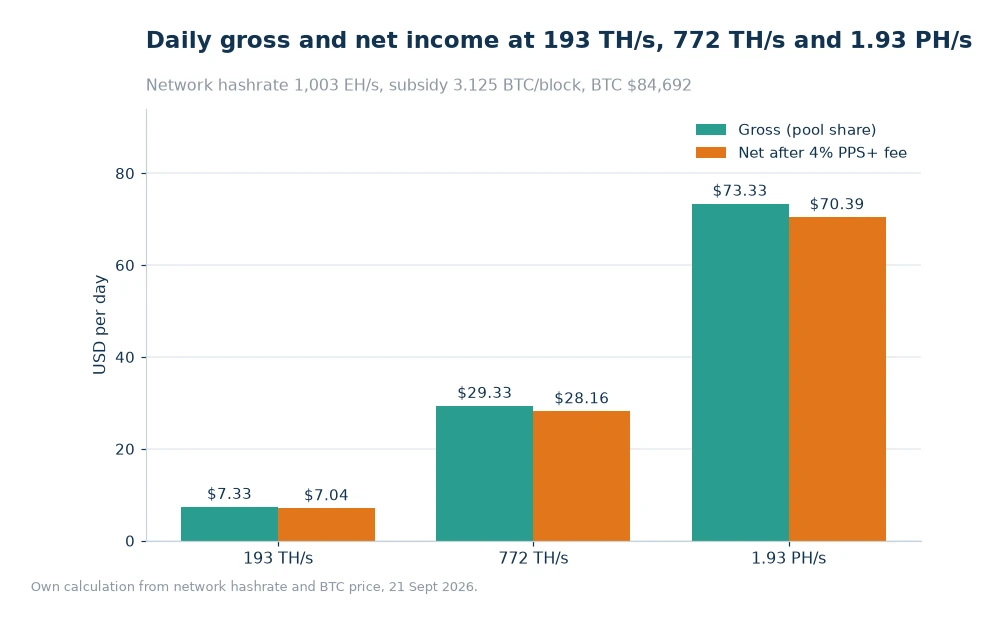
A rig running 193 TH/s produces about 0.00008659 BTC a day, which is $7.33 at $84,692 a coin. When a bill lands — a replacement PSU, a customs charge, a power deposit — the miner usually faces a choice between selling part of the stack and borrowing against it. Borrowing keeps the coins but adds a repayment schedule, and that schedule is the part worth stress-testing before anything is signed.

Key takeaways
- Collateral-Pledged Loans run in a fixed order: Add Collateral, Apply for Loan, Receive Loan, Repay Loan, Redeem Collateral.
- At 193 TH/s the net credit is close to $7.04 a day, so a $500 draw needs roughly 71 days of output to clear.
- PPS+ carries a listed 4% on the block-reward part and 2% on the fee part; those are separate components, not one combined charge.
- A plan priced on a single day's rate needs slack, because difficulty and the BTC price both move.
The sale you are trying to avoid
Selling coins to settle a bill is simple and final. The coin leaves, the bill clears, and the operation continues with one less asset on the books. Borrowing splits that single decision in two: the coins stay where they are, and a debt takes their place at the margin. Whether the split helps depends on what the debt costs against what the retained coins are expected to do, and on whether the miner can service the debt out of ongoing output rather than out of hope.
For a small operation the second half of that sentence matters more than the first. A rig earning seven dollars a day cannot absorb a large monthly payment even if the coins it kept later turn out to be worth more. The practical ceiling on a borrow is therefore set by daily credits, not by the size of the stack. That is an unusual way to think about collateral, and it is the one that keeps a miner out of trouble.
What the collateral has to cover
Collateral is not a valuation exercise; it is a buffer. The platform states the ratio it requires, and the miner's job is to sit far enough above that line that an ordinary price swing does not force a top-up or a liquidation at the least convenient moment. Posting exactly the minimum turns a routine dip into an administrative emergency, and emergencies in this market tend to arrive at the same time as cheap hardware and expensive coins.
The posted coins sit inside the multi-currency wallet tied to the mining account, which keeps the paperwork in one place: the same balance that receives payouts can hold collateral and receive the loan. One statement, one set of balances, fewer places for a figure to go missing. That sounds like housekeeping, but reconciliation is where most small miners lose an afternoon they could have spent on a fan swap.
The five stages, in order
The ViaBTC Crypto Loan flow is deliberately linear: Add Collateral, Apply for Loan, Receive Loan, Repay Loan, then Redeem Collateral. Each stage has a precondition, and the one people rush is the first. Adding collateral is not a formality; it fixes the number that everything afterwards is measured against, including the point at which a shortfall appears.
Repayment is where the timetable meets reality. Partial payments, the currency a repayment is made in, and the order in which interest and principal are applied all change the effective cost. Get those three answers in writing before drawing, not after the first payment has already gone out. A loan that looked cheap at application can turn expensive if the only accepted repayment route forces a conversion at a poor moment.
Repayment capacity by hashrate
The table turns the same arithmetic into a repayment clock. Net figures apply the 4% posted charge to the block-reward piece and leave the transaction-fee piece on its own 2% basis, which is as close as one column can get to the published schedule. Treat the final column as a floor on time, not a forecast.
| Hashrate | Net BTC per day | Net USD per day | Days to clear $500 |
|---|---|---|---|
| 193 TH/s | 0.00008313 | $7.04 | 71 |
| 772 TH/s | 0.00033251 | $28.16 | 18 |
| 1.93 PH/s | 0.00083127 | $70.39 | 7 |
Read the first row as the honest one for a single machine. Seventy-one days is more than two months of uninterrupted running to retire a modest draw, and any week of downtime pushes it out further. If the cash need is really a working-capital gap rather than a one-off repair, the borrow is probably too large for the hashrate behind it.
What a 2% difficulty move does
Chain data read on 21 Sept 2026 put the forthcoming adjustment at −2.12%. A fall of that size raises output per terahash by a little over 2%, which on the 193 TH/s row trims about a day and a half from the 71-day repayment clock. That is a real improvement and a small one. It should not be the reason a borrow works.
The same logic runs the other way, and that direction deserves more attention. Difficulty has spent most of its history climbing, so a plan that only survives a downward adjustment is a plan built on the best case. Leave room for the number to move against you by several percent and for the BTC price to do the same; the buffer is cheaper than the margin call that replaces it.
Terms that decide the real cost
Four contract details carry most of the risk. The term sets how long the obligation runs past the point where the hardware may be worth replacing. Early settlement tells you what it costs to get out when the machine dies. The top-up rule defines how quickly a price fall becomes a demand for more coins. And the redemption condition states what must be true before the collateral comes back.
None of these is exotic, and all of them are answerable in a short conversation before the first draw. A miner who can recite the four answers has effectively underwritten the loan. One who cannot is relying on the platform's defaults, which are designed to protect the platform.
Worked example: the 193 TH/s line by hand
Start with the per-terahash rate and build upward. Every figure below uses the same inputs as the chart, so the arithmetic can be checked line by line.
- Network output per TH/s: 450 BTC a day ÷ 1,003,000,000 TH/s = 0.00000044865 BTC.
- At 193 TH/s: 193 × 0.00000044865 = 0.00008659 BTC a day.
- In dollars: 0.00008659 × 84,692 = $7.33 gross.
- Net after the 4% charge on the block-reward piece: 0.00008659 × 0.96 = 0.00008313 BTC, or $7.04.
- A $500 draw ÷ $7.04 a day = 71 days of credits.
- Two weeks offline inside that window adds 14 days, taking the clock to 85.
Frequently asked questions
Do I have to sell coins to get a loan?
No. Collateral-Pledged Loans let you post coins instead, so the stack stays intact while the draw is outstanding; at 193 TH/s the credits behind the repayment are about $7.04 a day, which sets the pace rather than the size of the stack.
How long does a $500 draw take to repay?
About 71 days at 193 TH/s if the machine runs continuously and BTC stays near $84,692, since 0.00008313 BTC a day is worth $7.04 and 500 ÷ 7.04 is just over 71.
What if difficulty falls as estimated?
A 2.12% fall lifts output per terahash by a little over 2%, which shortens the 71-day clock by roughly a day and a half; useful, but far too small to justify a draw that the current rate cannot carry.
Fix the repayment date before you apply
Write down three numbers on one page: the net daily credit your machines produce, the draw you need, and the date by which the credits should have cleared it. If the date sits comfortably inside the term and leaves room for a fortnight of downtime, the structure is sound. If it only works when everything goes right, reduce the draw or sell a slice of the stack and keep the schedule out of it. The Profit Calculator will give you the first number at current difficulty; the second is your decision.
Sources: ViaBTC loan, wallet and pricing pages, plus chain data read 21 Sept 2026 — network hashrate 1,003 EH/s, difficulty 132.76 T, 3.125 BTC per block, 144 blocks a day, BTC $84,692. Figures are arithmetic on those inputs and assume steady uptime. Published 24 Oct 2026[1].